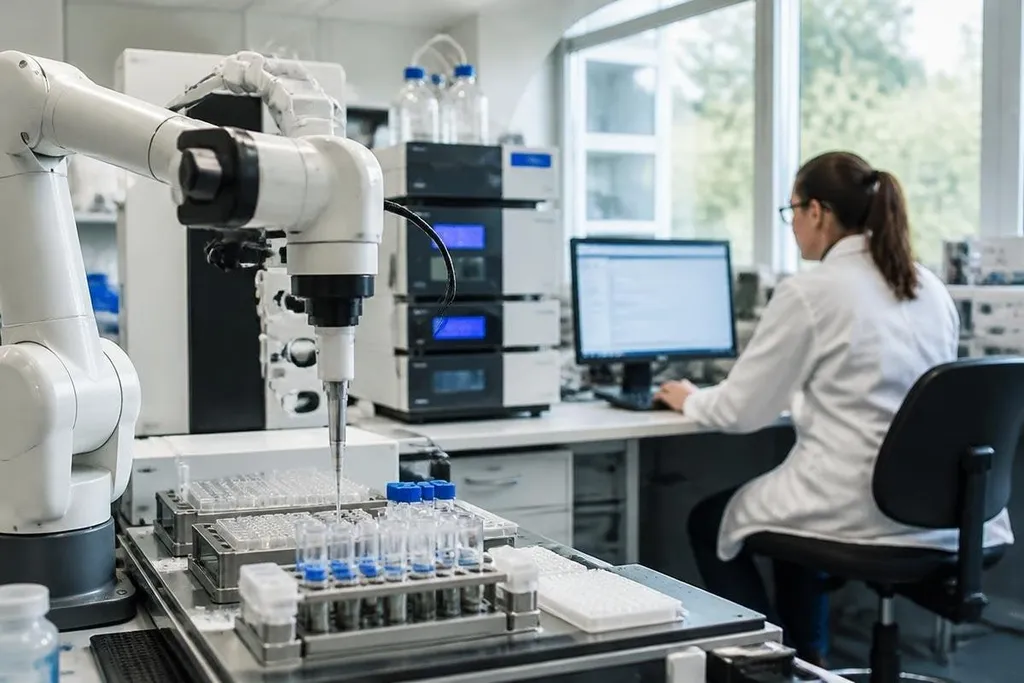
A laboratory robot can move samples, add liquids, read instruments, and record results while a scientist works elsewhere. The useful change comes when software links those actions into a repeatable experiment, then uses each result to choose the next step.
For a lab weighing automation, the real question is not whether a robot can move a tube. It is whether the complete setup can handle errors, record its work, and stop safely when a result looks wrong.
- Robots can repeat timed steps with the same motion and volume.
- Software can connect sample handling with instruments and records.
- Human review still matters when samples, tools, or results fall outside set limits.
What the robot actually does
A lab robot usually works through a set of fixed actions. It picks up a plate or tube, moves it to a new position, dispenses a measured liquid, waits for a set period, and sends the sample to an instrument.
A gripper handles solid items; a pipetting tool moves liquids.
Sensors add information that a fixed machine cannot get from a script alone. A camera can check whether a tube is in the expected position. Force sensing can show that a tool has touched a surface. Software can compare those readings with permitted ranges and pause the run when they do not match.
That matters because a missed pickup can spoil every later step. If the system records the failed action and the sample location, a technician can find the problem without searching through handwritten notes or disconnected files.
The experiment becomes a loop
A scripted robot follows the same sequence each time. A more capable setup adds a feedback loop: it runs a test, reads the result, and selects a later condition from rules set by the research team.
For example, software might change the next liquid volume after a measurement falls outside a target range. The robot then prepares the next sample, runs the same check, and stores the new result beside the first one. This turns the lab into a system that can run many small trials without asking a person to start every cycle.
The loop needs clear limits. A program should state which values it may change, how many runs it may start, and what result requires human approval. Without those limits, a small reading error can send later trials in the wrong direction.
Those limits matter when a lab robot turns a bad reading into its next instruction. Scientific robotics reporting from Robot24.com can tie the task to the sensor data and approval step before the next section tests where the process can fail.
Where automation can fail
Liquid handling is sensitive to tool position, liquid type, temperature, and the condition of the pipette tip. A robot can repeat a motion accurately while still producing a poor result if the tip is blocked or the sample behaves differently from the setup used during calibration.
Contamination creates a second risk. The system needs rules for clean and used tools, sample order, waste handling, and access to the work area. A log should show which tool touched each sample and when the action happened.
Software errors matter too. A connection failure can leave an instrument waiting while the robot continues with the next step. Good systems check the instrument response, save each action, and stop when a required reply does not arrive.
I’d start with one narrow experiment rather than give a robot control of a whole lab. That makes faults easier to trace and gives the team a clear record of what the machine can handle.
A practical setup checklist
Before a lab buys equipment or writes a long run script, check these points:
- Name the repeated work: choose a process with stable sample types and clear steps.
- Map each handoff: record how samples move between tools, instruments, storage, and waste.
- Set stop rules: define readings, positions, and connection failures that pause the run.
- Keep a full log: save timestamps, sample IDs, tool actions, instrument replies, and changes to the script.
- Plan human review: decide which results need approval before the robot starts another cycle.
The best first project has a small number of tools, a clear result, and a failure that a person can inspect. Start with one instrument and one sample type, with human approval before each run. Expand after the logs show that the robot repeats the process without hidden errors.